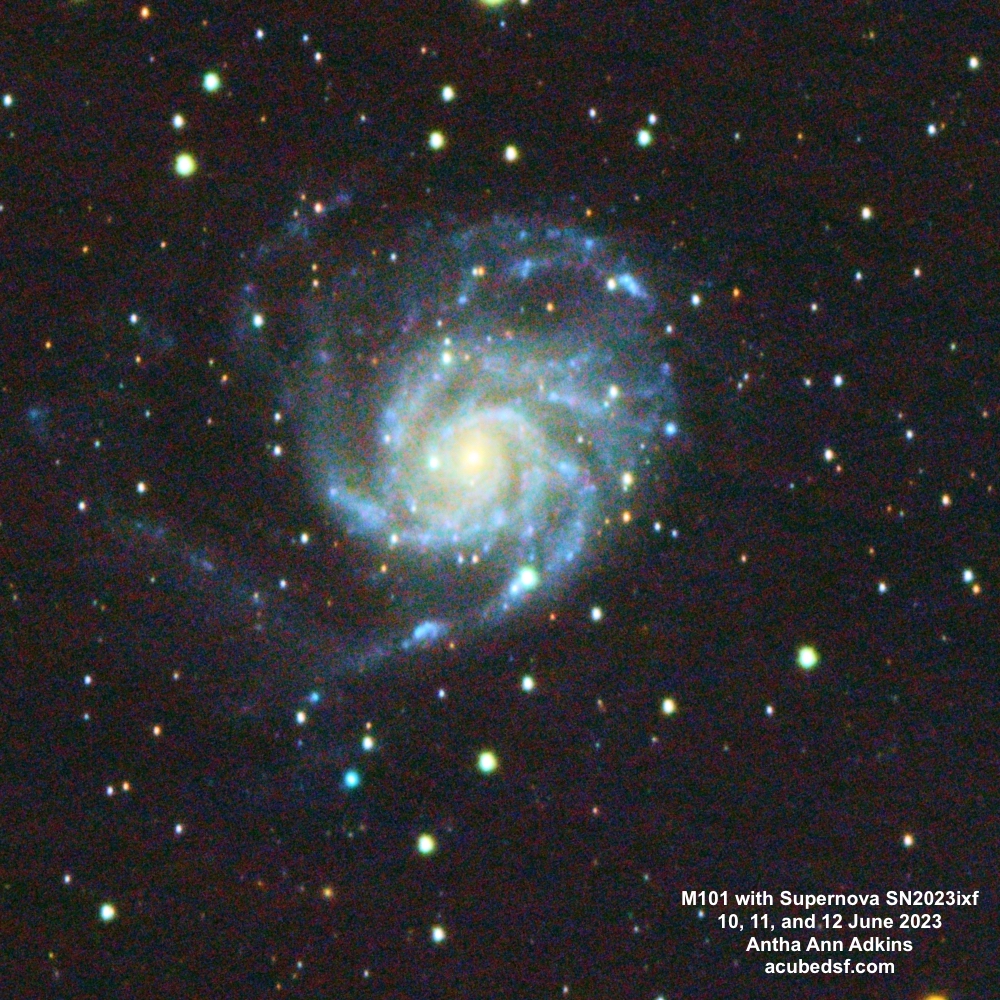
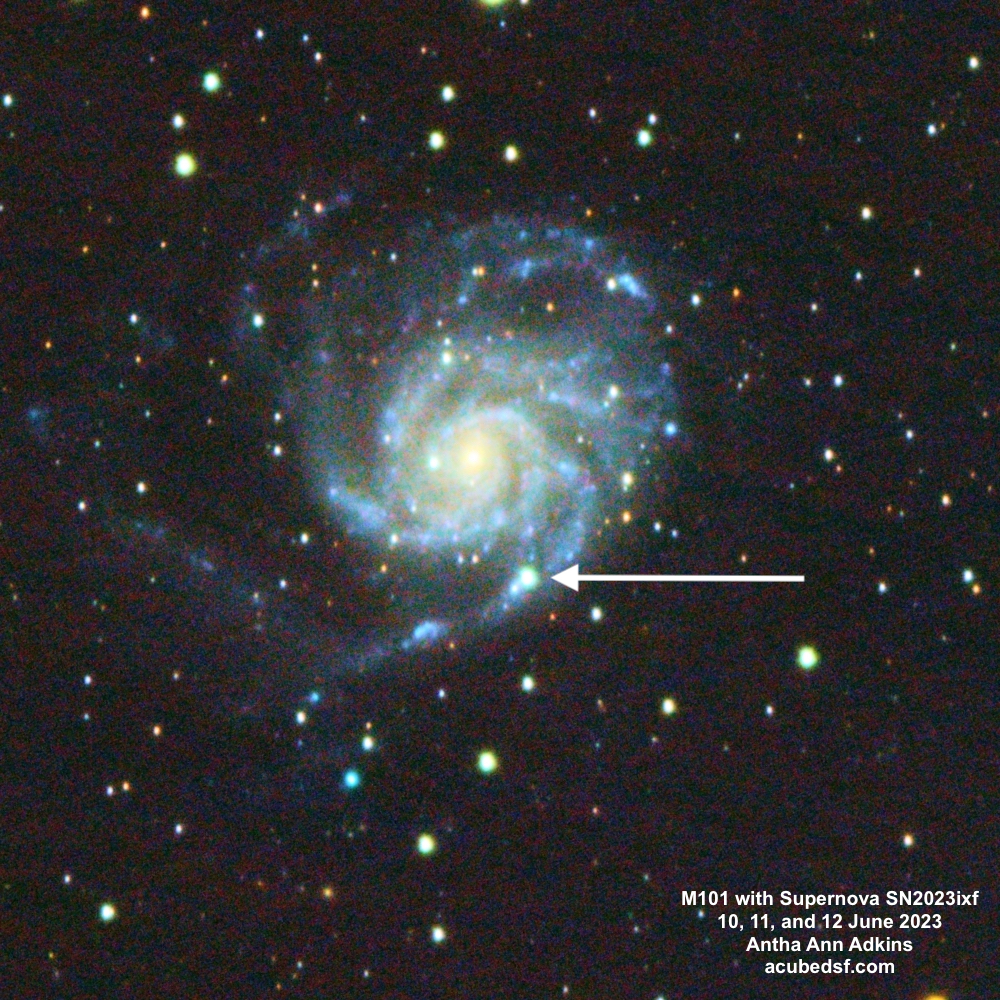
We recently went out to visit our favorite dark skies spot, Dell City, Texas, and we enjoyed 5.5 cloud-free nights and I collected over 30 hours of data. I spent most of that time on M101 and the supernova (arrow points to the supernova).
One of the things I’ve taken to doing is taking flats and dark flats before doing a meridian flip so each run is processed with its own calibration frames. That way if I bump the camera or reorient it, the flats will match the lights.
Now that I’m home, I’m processing the data. I didn’t use StarXterminator to separate the stars from the galaxy because I wanted the galaxy and the supernova to be processed the same way.
A couple of the light frames were thrown out by PixInsight, so this image ended up using 306 2-minute lights for a total of 10.2 hours of data. Compared to what I could get from my driveway, I think it was worth it!
Camera geek info:
- Canon EOS 60D in manual mode, 2 minute exposure, ISO 1600 and ISO 2000, custom white balance 3500K
- Williams Optics Zenith Star 73 III APO telescope
- Williams Optics Flat 73A
- iOptron CEM40
- Dell City, Texas Bortle 2-3 dark skies
Frames:
- June 10, 2023
- Run 1 1600 ISO
- 99 2 minute lights
- 31 0.01 second flats
- 20 0.01 second flat darks
- Run 2 1600 ISO
- 39 2 minute lights
- 31 0.02 second flats
- 30 0.02 second flat darks
- 71 2 minute darks
- Run 1 1600 ISO
- June 11, 2023 2000 ISO
- 151 2 minute lights
- 31 0.02 second flats
- 20 0.02 second flat darks
- 31 2 minute darks
- June 12, 2023 2000 ISO
- 30 2 minute lights
- 31 0.02 second flats
- 30 0.02 second flat darks
- 32 2 minute darks
Processing geek info:
- PixInsight
- Generalized Hyperbolic Stretch
 Space&Aliens
Looks great!
Thanks! I really wanted a high quality capture of this one before the supernova fades.